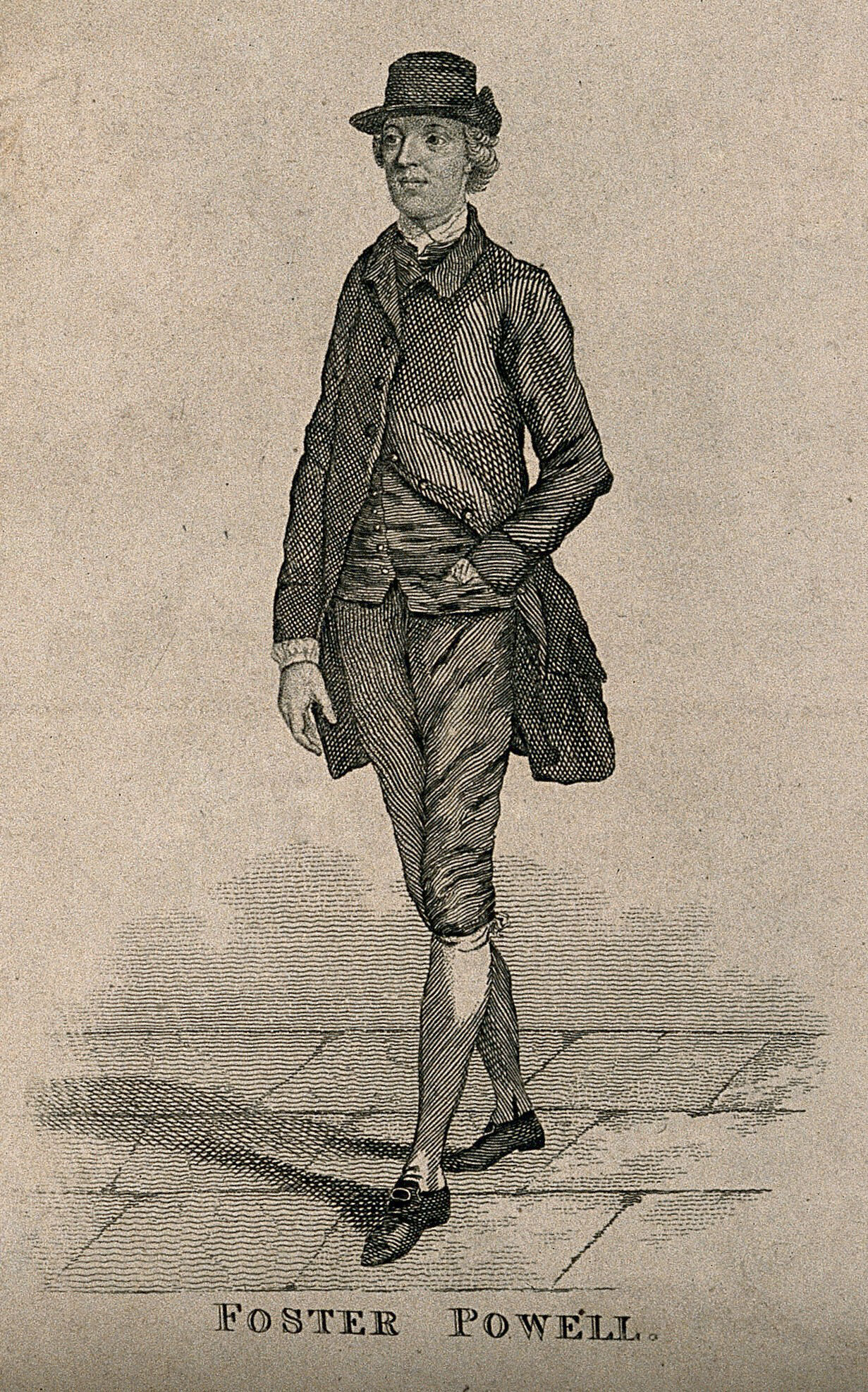
Foster Powell (1734–1793)
“Patron Statesman of The Great English Way”
Foster Powell was a modest legal clerk from Clement’s Inn, London, who became the founding figurehead of English Pedestrianism. Reserved, grave, and entirely indifferent to personal wealth, literary fame, or public accolades, Powell captivated 18th-century Britain through unprecedented feats of endurance across the nation’s turnpike roads.
Rather than seeking financial gain, Powell walked from an innate love of the journey itself. His physical discipline was legendary:
- 1764: Walked from London to Bath and back (198 miles) in 43 hours.
- 1773: Completed his famous London-to-York-and-back journey (396 miles) in 5 days and 18 hours.
- 1792: Set his personal record on the London-to-York route at age 58, completing it in 5 days, 15 hours, and 15 minutes.
Powell wore no cushioned footwear, carried no technical gear, and relied on no modern luxuries, pacing the hard turnpikes in unpadded leather shoes, wool broadcloth, and natural linen. His sustenance was radically simple—consisting of tea, small bits of toast, and milk. When met by cheering crowds at turnpike gates, he accepted no grand fanfare, quietly returning to his clerk’s desk when the walk was done. As noted in his 1793 obituary in The Morning Chronicle, he left behind a name untarnished by greed and a record of human endurance that future ages might admire, but rarely equal.
Why Foster Powell is Our Patron Statesman
Where traditional long-distance paths rely on medieval religious dogma, ecclesiastical saints, or commercial tourism, The Great English Way looks to an ordinary man of extraordinary quiet discipline.
As our Patron Statesman, Foster Powell represents a secular, civic benchmark of character and the embodiment of the “secular pilgrim.” He was a man who worshipped no system, accumulated no riches, and sought no institutional grace. By positioning him as our guide, The Great English Way reclaims long-distance walking as a universal human birthright—establishing a neutral cultural territory open to all freethinkers, wanderers, and sanctuary seekers.
Our adherence to his ethos rests on three core pillars:
- Radical Self-Reliance: Proving that the human frame requires no synthetic armour, petroleum-based membranes, or modern luxury to meet the English elements directly.
- Quiet Humility: Walking not for vanity, political conquest, or corporate sponsorship, but for the internal mastery and mental clarity of the journey itself.
- Universal Sanctuary: Establishing an open, democratic baseline of physical resilience that belongs to anyone willing to step onto the road with a stout heart and an open stride.
Pedestrianism and Its History
Long before the era of technical outdoor gear, commercial trail sponsorships, and plastic-wrapped convenience, Pedestrianism stood as a pure, uncompromising discipline. In the late 18th century, pedestrians were the endurance athletes of extraordinary mental fortitude who covered hundreds of miles along Britain’s turnpikes on foot, relying on nothing more than simple natural attire, minimal rations, and an unyielding pace.
Historical accounts from the era capture the sheer scale and character of this movement:
- On Setting Out (The Public Ledger, November 1773): Chronicled Powell setting out from Hicks’s Hall, London, to walk to York and back in six days for a wager of one hundred guineas, reaching Stamford (86 miles) before nightfall at an even, steady pace that confounded those riding alongside him.
- The Return (The Gentleman’s Magazine, 1773): Recorded his arrival back at Hicks’s Hall after completing nearly 400 miles in 5 days and 18 hours, noting how he avoided all parade, entering a coach to escape the huzzas of the crowd and retiring quietly to his lodgings.
- His Remarkable Temperance (The Sporting Magazine, 1792): Documented his abstemiousness on the road, observing that vigor of body depends not upon gross feeding, but upon temperance, rhythm, and a diet of tea, toast, and milk that kept his breath clean and limbs elastic.
The Foster Powell Challenge
The Foster Powell Challenge is the foundational speed and physical baseline for The Great English Way. It is a 350-mile (666 km) continuous pedestrian path connecting the historic quays of Falmouth (starting at Little Dennis) to the ancient terminus of Canterbury Cathedral.
The challenge serves as a direct rejection of modern ultra-endurance culture and its reliance on petroleum-based synthetics, cushioned soles, and digital metrics. It is a proof of concept that the human body remains a formidable machine when released from the cage of modern luxury, governed by four operational principles:
- Unvarnished Endurance: Traversing 30 to 40 miles a day powered strictly by plant-based nutrition and unassisted human effort.
- Circular Ecology: Zero new demand for plastic gear; utilizing pre-owned natural textiles (wool, linen, and unpadded leather) that leave no microplastics in English waterways.
- Radical Simplicity: Carrying only what fits in a single-strap canvas haversack, stepping entirely off the grid of modern consumerism.
- Physical Truth: Facing the English wind, rain, and road directly—without synthetic buffers—to rebuild structural integrity in arches, tendons, and ankles while forging genuine mental fortitude.
The Foster Powell Milestone at Maiden Castle & A History of Maiden Castle
As the route climbs onto the South Dorset Ridgeway (Stage 12, OS Explorer 117 — SY 669 884), the trail enters a high chalk corridor that has carried human footfalls for over four thousand years. Rising out of the landscape like a sleeping leviathan at the exact 333 km (206.5 mile) midpoint mark stands Maiden Castle.
The History of Maiden Castle Covering 47 acres, Maiden Castle is one of the largest and most complex Iron Age hillforts in Europe. Long before turnpike roads, administrative ledgers, or modern machinery existed, ancient communities carved its massive chalk ramparts and deep ditches using nothing more than red deer antlers, wooden shovels, and unassisted human effort. It stands not as a monument to kings or conquerors, but as an enduring testament to what collective human physical grit can construct directly out of the bare earth.
The Foster Powell Benchmark Stone Set directly into the chalk turf alongside the trackway at Maiden Castle sits the hand-carved Foster Powell Benchmark Stone. Marking the precise geographic halfway sanctuary of The Great English Way, it honours our Patron Statesman with an inscribed reminder of his enduring philosophy:
THE GREAT ENGLISH WAY333 KM / 206 MILES TO CANTERBURY THE FOSTER POWELL BENCHMARK (1734–1793)Patron Statesman of the Open Road
“He sought no luxury on the turnpike, requiring only simple sustenance, a stout heart, and the open road before him.”